Within the College of Liberal Arts there are faculty and staff that work with multiple departments and thus need to be listed as a contact on multiple department and center website people directories. Thankfully, our WordPress Multisite system allows us to create a user profile for someone once and share that data across multiple sites. This allows the person to update their profile in one location and have it automatically update every site on which they're listed. The only complication is that the person must be a member of each site they need to be listed on, and making someone a member of a site can only be done by an administrator.
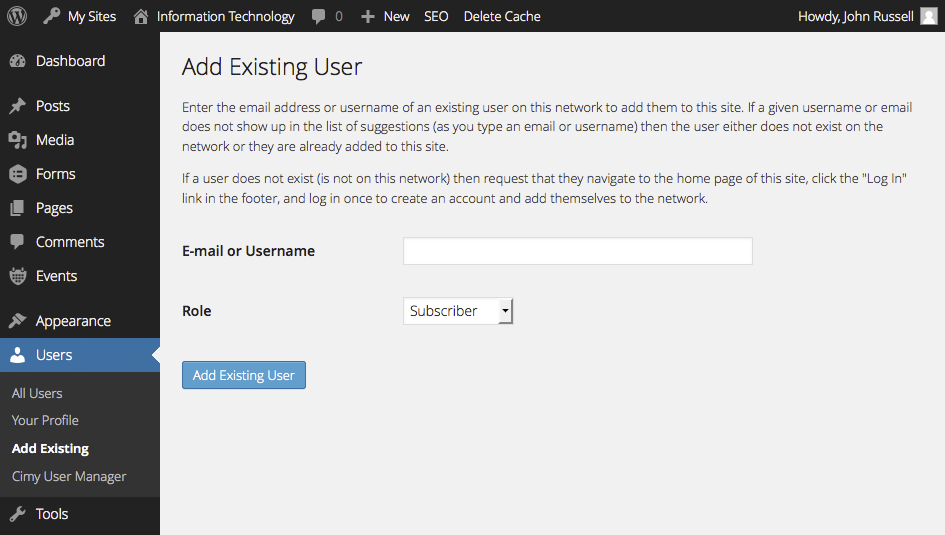
Screenshot - add existing user

Until now Site Managers needing to add someone (who already had an account on Multisite) to their website's people directory needed to notify us and we could add them. This adds work for Site Managers and us, and though it may be small every little bit counts so yesterday we created a new page in the Users section of the WordPress dashboard called "Add Existing". This page allows Site Managers to type in an email address or eName of anyone who already has an account on Multisite, select a role, and add them as a member of their website. Once added they can be listed on people directory pages and their profile can be viewed in the host website design.

It's not a huge change but it's one more step towards our mission, with the WordPress Multisite system, of empowering our departments and centers with control over their own websites.

Tech note: WordPress technically has this functionality built in, but only super-administrators can add an existing user as a member of a site without sending an invitation email to a person, which requires action on said persons part. The new "Add Existing" page allows Site Managers to add existing users immediately, without sending an invitation email.

Comments

  1. Thank you for sharing such insightful and updated information. The articles are well-written, organized, and filled with useful knowledge. I appreciate your effort in producing content that benefits readers.

  2. Thank you for posting this well-written article. The explanations are clear, informative, and easy to follow. I appreciate the effort behind creating content that is both useful and educational for readers.

  3. AI-assisted drafts often need more than corrected grammar: they need varied sentence rhythm, clearer transitions, and wording that fits the intended audience. An AI humanizer can support that revision process across Spanish, Portuguese, English, and Japanese, especially when the original draft sounds repetitive or overly formal. The final text should still receive a human review for factual accuracy, tone, terminology, and any subtle change in meaning introduced during rewriting.

  4. PDF attachments often become a practical issue on shared websites when staff need to upload forms, reports, biographies, or downloadable resources. ComprimirPDF offers a focused way to reduce those files in the browser without registration or server uploads. Local processing can be especially useful when a document includes internal details or personal information that should not be sent to an additional service. Smaller files may also make downloads easier for visitors on slower connections. After compression, checking text clarity, embedded links, and image quality helps ensure that the document remains usable.

  5. A useful tattoo brief should describe more than the central subject. It can specify placement, approximate size, line weight, shading, color limits, and the amount of open skin between separate pieces. Visual concept tools can help compare those choices before an artist consultation, especially when several small motifs must feel related without looking like a single sleeve. The generated image should remain a discussion reference, while the tattoo artist adapts composition and detail to the body.

  6. Spanish writing often needs more than a basic word total. Contador de Palabras combines live counts for words and characters with sentence analysis, readability indicators, keyword review, and rhythm checks. Bringing these signals into the editing view can help writers spot dense passages, excessive repetition, or sentences that interrupt the flow. It is relevant for articles, academic drafts, marketing copy, and any text that must fit a defined length while remaining clear and natural.

  7. A practical content workflow needs a stable draft that several people can review without losing the original message. HumanAIEdit addresses a relevant stage in that process: turning AI-assisted material into clearer, more natural, and still-editable copy. The strongest approach would keep terminology consistent across articles while allowing each author or department to retain an appropriate voice. Version comparison, factual review, and a final read for context are still essential before publication.

  8. Writers working with Japanese submission rules often need several measurements at once. A 原稿用紙 estimate translates the raw total into familiar 400-character pages, while separate counts for lines and paragraphs help with formatting checks. UTF-8 and Shift_JIS byte totals address a different requirement: technical storage or form limits. Updating all of these values in real time, with the text processed only in the browser, makes the calculation useful for both editorial planning and privacy-sensitive drafts.

  9. A local pdf converter is especially useful when the document contains notes, reports, or other material that should not be uploaded to an application server. Processing in the browser also removes the need to create an account before extracting editable Markdown. The practical boundary matters: text-based PDFs and clear English scans are suitable inputs, while complex layouts, handwriting, or poor scans may still require manual cleanup. Keeping headings, lists, and paragraphs editable makes the result easier to revise, search, or move into a documentation workflow.

  10. For teams managing several websites, content operations can become fragmented surprisingly quickly. RankOps AI addresses that problem by combining site-fit keyword research, editable draft creation, content review, and approved publishing through connected website workflows. Keeping these stages in one system can make ownership and status clearer: an opportunity is selected, a draft is prepared, an editor checks it, and only approved material moves forward. This model is especially sensible where accuracy and brand consistency matter, because automation supports the work without removing the human decision at the publishing boundary.

  11. Many hiring tools organize applicants or schedule interviews, but preparation quality depends on connecting the role’s requirements with the candidate’s specific claims. A useful interview guide should identify what needs verification, propose focused questions, describe credible answer signals, and suggest evidence to request. This gives the interviewer a practical route from a broad resume statement to a detailed discussion of scope, decisions, and individual contribution. The resulting structure can support consistency across interviewers while keeping every conversation relevant to the position.

  12. Choosing HR software becomes easier when the comparison starts with workflows rather than feature counts. A small organization can list its recurring tasks, identify where information is duplicated, and decide which records require permissions or audit history. Vendor comparisons should then cover integrations, data export, implementation effort, support, and total cost alongside core functions. It is also worth separating essential requirements from conveniences, because an oversized system can add administration without resolving the team’s most important bottlenecks.

  13. Punctuation marks that resemble one another can change the rhythm and meaning of a line. A middle dot is particularly useful when a separator should feel lighter than a dash yet more visible than a regular space, such as between compact labels or related terms. A good reference should make this distinction clear and show neighboring alternatives, helping users select a character based on reading flow instead of simply choosing the first similar mark available.

  14. Event information: WordPress Multisite shared faculty profile management feature introduction
    Content type: College of Liberal Arts website technical update
    Content overview: New “Add Existing” page released in WordPress dashboard for site managers to add existing multisite users to local website independently
    Web content can be made into attractive short videos with imagine-video.

  15. Learning Morse is easier when a tool supports both reading and listening. A clear alphabet reference helps users spot a mistaken character, while audio playback makes timing more concrete than a written sequence alone. Morse Code Translator also supports conversion from signals back into readable text, which is useful for checking practice exercises or decoding a saved note. Keeping copy and downloadable formats nearby turns a simple converter into a more complete study and communication aid.

  16. Really nice post. I’ve been exploring voxel game recently, a free browser voxel builder for cozy isometric scenes, and your article matches my own experience perfectly. Thanks for sharing.

  17. Adding users on Multisite is a sequence of admin screens, not one settings JPEG. I split those WordPress shots into a grid in the browser with ImageSplit, nothing uploaded. The steps read better as tiles.

  18. The idea of one profile shared across sites is what makes multisite actually useful for overlapping departments. I hadn’t thought about how much simpler it is when someone updates their details in just one place. For admins sketching a shared directory layout, planning the structure first with perler bead patterns can help visualize how each block fits together. Does a profile update reach every site right away, or does it depend on how each site pulls the shared user data?

  19. This is a helpful resource for managing users across multiple department sites. I appreciate how the WordPress Multisite setup allows centralized profile updates. It reminds me of how flexible tools can streamline workflows, much like finding a good pixel game to relax after work. Thanks for clarifying the process so clearly.

  20. The new “Add Existing” page under Users is the part that matters — having to email an admin just to get one shared faculty profile onto a second department site was always a silly bottleneck. I actually used a Strands solver to keep my brain busy during a similar directory cleanup last week, since it gives hints gradually instead of dumping the answer.

  21. Great WordPress Multisite tutorial clearly explaining how to add existing network users to individual sub-sites! Managing user roles and site permissions centrally makes WordPress network administration so much more efficient. During my downtime after reviewing CMS support blogs and WordPress admin guides, I love relaxing by making quick tunes on Online Keyboard Synth directly in my browser. Thanks for sharing this helpful IT support guide!

  22. What an encouraging technical post celebrating helpful documentation, smooth team collaboration, and efficient site management! Supporting colleagues and site editors with clear technical instructions brings so much order to daily workflows. For webmasters, IT staff, and readers seeking a quick moment of daily inspiration and quiet reflection alongside WordPress administration research, checking out a Random Bible Verse Generator offers a wonderful source of daily encouragement. Thank you for publishing this inspiring support guide!

  23. Great step-by-step breakdown on searching existing usernames, assigning site roles, and managing multisite user access! Having clear screenshots and administrative steps eliminates confusion when granting sub-site access to team members. When taking a break from reading IT support blogs and writing down WordPress admin notes, I enjoy using typography tools like Text to Cursive to convert plain text into elegant handwritten fonts. Thanks for sharing these well-structured admin tips!

  24. Spot-on IT feature capturing user role delegation, Multisite dashboard navigation, and bulk user assignments for WordPress sites! Direct step-by-step support guides save site administrators so much troubleshooting time. Whenever I need a quick mental break after researching WordPress multisite setups and reading CSU Liberal Arts IT blogs, I like to relax with casual browser games like Krillion Game. Appreciate CSU Liberal Arts IT publishing this detailed walkthrough!

  25. Thanks for detailing the user lookup process, role permission levels, and Multisite backend steps for adding existing users. Understanding how university IT portals and CMS support blogs format technical documentation behind the scenes is always fascinating. Outside of following web administration trends and tech blogs, I enjoy testing out simple web utilities—like using a Binary Code Translator to encode plain text into binary codes for fun. Looking forward to reading your next WordPress support guide!

  26. The detailed walkthrough of network user integration, role assignments, and sub-site permissions in this guide is super practical for WordPress site managers. Streamlining user access across multisite networks truly saves valuable administrative time. During my downtime after reviewing CMS administration articles and reading IT support blogs, I like to unwind with word puzzles and check solutions on Bubble Word Jam Answers to give my mind a quick refresh. Thanks for providing this thorough WordPress guide!

  27. Using one shared profile across multiple department and center directories is a practical WordPress Multisite solution. Automatically syncing updates from one location should save staff from maintaining duplicate information across sites.

  28. Using a single WordPress Multisite profile across multiple department directories is a smart way to prevent outdated contact information. It also saves faculty and staff from having to update the same details repeatedly across different sites.

  29. Good to see the IT page kept practical – the note about staff juggling multiple departments matches what I hear from most small teams. Disclosure: I build an AI image tool, so I read IT pages looking for how teams actually share tooling.

  30. On add existing users site, the stills survive and the video does not. The stills on that page hold up; the attached clip usually does not. I keep the original MP4 and reconstruct it to 1080p so the motion does not flicker after a feed crush.

  31. The new “Add Existing” page is a smart fix: letting Site Managers add a Multisite user immediately without an invitation email removes a real bottleneck for shared people directories. One practical caveat is that silently adding someone means they may not realize they’ve been listed; a lightweight notification or dashboard reminder would help. Role selection also deserves caution, since broader access can be granted alongside directory listing.

    Convert any PDF to dark mode in your browser.

  32. Using a single WordPress Multisite profile for faculty and staff who appear in multiple department directories is a practical way to prevent inconsistent contact information. The centralized update process should save administrators considerable time while keeping each site current.

  33. Creating user profiles for faculty and staff in multiple departments is streamlined by the WordPress Multisite system, allowing for one-time profile updates to sync across all sites—just ensure each person is a member of the sites they need to be listed on. With ProductToPin, you can also streamline the creation of Pinterest graphics by converting a single product page into five custom creatives.

  34. Using one shared WordPress Multisite profile for faculty and staff across multiple department directories is a practical way to prevent inconsistent contact information. The centralized update process should save time while keeping every listing accurate.

  35. Converter Run is a file conversion suite for image, audio, video, and PDF. Planning happens with an AI chat while ffmpeg, canvas, and PDF work stay in the browser — files never leave your device.

  36. SnapGen is a customer portal for AI media generation: authentication, payments, API-key management, model discovery, and a playground backed by the SnapGen gateway.

  37. Vidrush is a free-to-start AI video suite for image-to-video, text-to-video, multi-model generation, scripts, voiceovers, captions, and viral templates. Creators can go from prompt or image to a social-ready clip in minutes.

  38. I deeply appreciate the richness of your writing style, which turns informative content into an enjoyable experience through clarity, thoughtful pacing, and an engaging tone that feels natural throughout.

  39. This article was such a satisfying read because the writing remained clear, elegant, and engaging while still delivering meaningful insight throughout.I admire how every section added something valuable without making the content feel overloaded or unnecessarily complicated at any point.

  40. This is a helpful guide for managing user profiles across multiple sites within the Multisite system. It saves time by allowing one profile update to reflect everywhere. I found a tool called face square generator that helps users with consistent avatars, which could complement this workflow nicely.

  41. Great explanation on managing user profiles across multiple sites. It’s helpful to know one update syncs everywhere. I wonder how this compares to a typical space game where progress doesn’t carry over between sessions? Either way, glad the system works smoothly for shared contacts.

  42. The new “Add Existing” page is a practical tweak—by letting site managers type an email or eName and assign a role, they can instantly add a user to a site without sending an invitation. This streamlines the process for faculty who already have a Multisite account, ensuring their profile updates propagate across all departments they belong to. It’s a small but meaningful step toward giving departments more autonomy over their own directories.

    You can generate Pokemon-style names that actually sound official.

  43. Using a single WordPress Multisite profile across departments is a practical way to keep contact information consistent and reduce duplicate updates. This should make maintaining shared faculty and staff directories much more efficient.

  44. The point about creating a user profile once and having it sync across multiple sites is a smart way to avoid duplicate work. I’m curious about that complication you mentioned at the end, since that’s usually where these setups get tricky in practice.

    AI video generator

  45. The point about updating a profile in one place and having it sync everywhere is exactly what makes a multisite setup worth the effort. I’m curious how you handle the edge cases, though, like when someone leaves one department but stays in another. Does the shared profile just get unlinked from the old site, or is there more cleanup involved?

    multimodal AI tool

  46. The point about updating a profile in one place and having it sync across every site is the real win here, especially for faculty who are spread across multiple departments. I’m curious how you handle the edge case where someone needs slightly different contact info or titles depending on which department page they appear on.

    Uni 1 AI

  47. The bit about updating a profile in one place and having it sync everywhere is the real win here, especially for faculty juggling multiple department listings. I’m curious how you handle the edge cases though, like when someone leaves one department but stays in another and their contact info needs to differ per site.

    hairstyle finder

  48. The point about updating a profile in one place and having it sync everywhere is the real win here, especially for faculty who straddle multiple departments. I’m curious what that “only complication” turns out to be, since shared profiles across sites usually run into permission or display issues somewhere.

    genderswap.net

  49. The point about updating a profile in one place and having it sync everywhere is exactly the kind of efficiency that saves staff from chasing down outdated listings. I’m curious how the system handles it when someone’s role changes but they still need to appear on some of the same sites.

    Mage-Flow

  50. The point about updating a profile in one place and having it sync everywhere is the real win here, especially for faculty juggling multiple department listings. I’m curious what the complication is that you mentioned at the end, since that’s usually where these setups get messy.

    minimax-h3.studio

  51. The point about updating a profile in one place and having it sync everywhere is the real win here, especially for faculty who are spread across multiple departments. I’m curious what that “only complication” is, since it sounds like the setup is otherwise pretty smooth.

    AI photo editor

  52. The point about updating a profile in one place and having it sync everywhere is the real win here, especially for faculty who are stretched across multiple departments. I’m curious what that “only complication” turns out to be, since shared profiles across sites usually run into permission or display issues somewhere.

    seedance25.online

  53. The point about updating a profile in one place and having it sync everywhere is the real win here, especially for faculty juggling multiple department listings. I’m curious how you handle the edge cases though, like when someone needs slightly different contact info or a title that varies by department. That seems like where the single-profile approach could get tricky.

    seedance25.jp

  54. The point about updating a profile in one place and having it sync everywhere is the real win here, especially for faculty who are spread across multiple department sites. I’m curious how the system handles it when someone needs slightly different contact info or titles for different departments, though. That seems like the kind of edge case that could get messy.

    seedance25-kr.com

  55. The point about updating a profile in one place and having it sync everywhere is the real win here, especially for faculty split across multiple departments. I’m curious though, what happens when someone needs slightly different contact info or titles depending on which department site they appear on? That seems like the tricky edge case once you move past the basic setup.

    텍스트·이미지 AI 동영상 제작

  56. The point about creating a single user profile and having it sync across multiple sites is really the key benefit here. I’m curious though, what happens when someone needs slightly different contact info or a unique title for different departments? That seems like where the “only complication” you mentioned would really come into play.

    image to video AI

  57. The point about updating a profile in one place and having it sync everywhere is the real win here, especially for faculty who are spread across multiple departments. I’m curious though, what happens when someone leaves or changes roles, does that single profile automatically get removed from all the sites it was shared with?

    MiniMax H3

  58. The point about updating a profile in one place and having it sync everywhere is the real win here, especially for faculty who are stretched across multiple departments. I’m curious how you handle the edge case where someone needs slightly different contact info or a different title depending on which department site they appear on. Does the shared profile system allow any per-site overrides, or is it strictly one version for everyone?

    fast AI video

  59. Useful walkthrough for anyone running a multisite install. On the media side of the same problem, the lab here now runs every captured clip through a tool to Create Depth Maps from Video before handing footage to students; depth ordering problems show up long before anyone notices them by eye. Do you keep a similar preflight step for video on your multisite?

  60. Using one shared profile across multiple department and center directories is a smart way to prevent inconsistent faculty and staff information. It also saves people from having to update the same details repeatedly across the WordPress Multisite network.

  61. Sharing one WordPress profile across department directories fixes the duplicate-bio problem. I walked through a similar multisite cleanup on a recording, then used whisperweb.dev to make the checklist.

  62. Using a single WordPress Multisite profile across departments is a practical way to keep contact information consistent. It also saves faculty and staff from updating the same details separately on every site where they’re listed.

  63. Clean and concise walkthrough on user management across multisite networks. Managing granular permissions and environments is always tricky when collaborative teams scale up. Still very applicable today!

  64. Using a single WordPress Multisite profile across multiple department and center directories is a practical way to keep faculty and staff information consistent. It also saves users from having to update the same details repeatedly across different sites.

  65. Clear step-by-step instructions like this make multisite administration much less intimidating. The reminder to verify the existing account before adding it is especially useful.

  66. Using one shared user profile across multiple department and center directories is a smart way to prevent outdated contact information. It’s especially useful for faculty and staff who work across several departments, since a single update can keep every site consistent.

  67. The shared user profile approach is a practical way to keep faculty and staff information consistent across multiple department and center directories. It’s especially useful that updates made in one location automatically propagate throughout the WordPress Multisite network.

  68. This is a useful reminder that multisite administration is mostly about keeping permissions explicit and repeatable. I also find it helpful to keep setup notes in one place; the Documentation is a concise reference for working through long technical material with a multimodal model.

  69. Clear guidance on keeping permissions explicit across a multisite network. I also like using a structured decision checklist when reviewing access changes; the Documentation has a concise reference for testing those decisions in an AI workflow.

  70. The shared user profile approach is a practical way to keep faculty and staff information consistent across multiple department and center directories. It also reduces duplicate updates, though the “only complication” makes me curious about how exceptions or site-specific details are handled.

  71. This is a helpful guide for managing user profiles across multiple department sites. It’s great that updates sync automatically once a profile exists in the multisite network. I also enjoy playing a space game during breaks, and it feels refreshing to switch between tech tasks and something as relaxing as that.

  72. This workflow still trips people up a decade later, especially when a super-admin has to clean up after a plugin created its own orphaned users. One thing we learned running a multisetup for our Free PSL Rating Test
    network: always check the user is not already attached to another site in the network before using Add Existing, or you get the confusing “user already exists” message with no hint about which site holds the account. The Users > Add Existing screen described here is much faster than inviting by email, which stalls when the notification lands in spam. Wish the core UI showed the per-site role assignment on the same screen instead of making you edit each user afterwards.

  73. Letting Site Managers add existing Multisite users themselves is a smart way to take small requests off the central team. For anyone onboarding new Site Managers on a change like this: a two-minute screen recording of the process plus a written checklist covers both kinds of learners. If the recording comes first, an AI video summarizer like transcript.im can turn it into a step-by-step summary you paste straight into the help article, and the timestamps make it easy to point someone to the exact step they’re stuck on.

  74. Sharing one profile across department sites is such a good fix for directories that used to drift out of sync. Related tip for Site Managers: people directories tend to keep listing contact emails for faculty and staff who have moved on, and visitors only find out when their message bounces. Exporting the directory emails once a semester and running them through bulk email verification flags the addresses that no longer exist, so the profile can be updated or removed before a prospective student hits a dead end.

  75. The user-by-user approach gets tedious fast once a network grows past a handful of sites. Something that has helped us: documenting role expectations before adding people, so editors don’t end up with admin rights they never need. When we audited our own toolstack alongside the multisite, a directory like DotCurio made it easier to keep track of what each platform actually does. One more thing worth remembering: removing a user from the network doesn’t always clean up their content, so it pays to audit posts before deleting accounts.

  76. This walkthrough saved us a ton of time – we run a Multisite for managing departmental directory profiles and the “add existing user” limitation was exactly the bottleneck described here. The new Add Multiple Users option is a welcome change; being able to paste a list of usernames instead of touching each site is a huge improvement for site managers. Would love to see a follow-up on bulk-removing users once their profile is no longer shared across sites. Bookmarking this one for our internal docs – I also keep a curated directory of AI and creative tools at SiftPort for research on admin tooling. Thanks for documenting it so clearly!

  77. Handy reference — the Users > Add Existing path is easy to miss when you are used to single-site installs. One thing we learned managing a multisite with several content teams: agree on role templates per site before adding users in bulk, otherwise the permission drift gets messy fast. We now also run decision checks on user-facing text across sites with a Free Laya Model Online playground (classifying requests and scoring replies) before rolling changes out network-wide. Super admin import via the user list is exactly right.

  78. “Every little bit counts” is exactly the right framing, turning a two-day round trip into one field on the Add Existing page. One gap worth checking: the directory is only worth much if it matches what people hear on the phone, and ours had three people with similar eNames, so reception was reading names back to callers to confirm which one they wanted. We ended up pointing the switchboard at an IVR voice generator so extensions and department numbers get read one character at a time.

  79. Adding a person to a second site is trivial, but it quietly makes them a contact on two directories and almost nobody reconciles those lists afterwards. The fields that hurt are the ones that look maintained but are not. We hit that with staff who had already left, where the directory still listed an office number and the first anyone knew was a bounce. Since then a number only goes onto a shared profile after a sms online, so the stale ones are obvious instead of being found out by a prospective student emailing a dead extension.

  80. The awkward part of multisite is that one person quietly becomes an admin on four sites and a subscriber on two, and nothing anywhere records who decided that. A follow-up on bulk removal would be genuinely useful, since the reverse direction is where the mess accumulates and the manual route is miserable at network scale. One habit that helped us: every shared profile gets its contact details re-checked on a schedule, and the ones staff change often get a sms verify pass before we treat them as current.

  81. The catch you flagged, that the person still has to be a member of every site before they can be listed, is exactly what our college hit too. We ended up writing a short internal doc with screenshots because the option is buried three levels down. Took me a few tries to find it, so thanks for spelling it out. For mocking up the new directory layout I have been leaning on a chat gpt image generator first.

  82. The one-profile-many-sites approach saved us the same headache in our faculty directories. Our own recurring snag was inconsistent image handling per site, and settling on a single generator across the network made the handoff far less painful. Seedance 2.0 online is what we standardised on.

  83. Using one WordPress Multisite profile across multiple department and center directories is a practical way to keep faculty and staff information consistent. It also significantly reduces duplicate updates when someone’s contact details or role changes.

  84. If the instrumental feels right, changing only the vocal can be a useful next step. Explore aisongcover.io to hear your track with a different licensed voice while keeping its musical foundation. Choose a licensed singer from the library, add your recording, and let the preview show the difference. You can browse licensed voices and hear samples before selecting one for your own cover preview. It is a helpful starting point for anyone exploring how performance affects a song. Every cover begins with a free 30-second preview, giving you a chance to listen before using credits for the full song. See whether a different delivery brings your favorite lyric into sharper focus.

  85. The distinction between a network-level account and membership on an individual site is helpful. Is the role assigned separately on each department site, so a shared profile can keep only the access needed for that site?

  86. The explanation that shared profiles still need site membership makes the access boundary clear. WordPress screens and permissions evolve, so checking current source docs before changing roles helps; AI Answer can gather up-to-date references. Thanks for clarifying the distinction.

  87. Adding existing users across a multisite network looks trivial until you manage a dozen sites. One tip from experience: the Add Existing User screen only accepts the email tied to the network account, not the username, and role mapping per site has to be redone each time. For teams that want structured, repeatable decisions around access approvals, we documented our model comparison here: Decision Models

  88. WordPress Multisite makes managing shared faculty profiles across multiple departmental pages so much cleaner than manually duplicating user data every semester.

    While setting up bio placeholders for a similar staff directory layout, I tested Seedance 2.5 to mock up brief introductory video loops. I had checked 시댄스 2.5 가격 beforehand to see if it made sense for my regular asset workflow, and running a simple prompt like “office headshot, subtle nod toward camera, soft key light” produced a solid four-second clip that fit the profile layout neatly without needing an actual studio setup.

  89. Clear walkthrough. The difference between adding an existing user and creating a new one on a multisite network trips up a lot of department admins. A side note from building department pages: when a group photo has a stranger in the background, I brush them out with RemoveGenie, a remove people from photo tool, before uploading. It works best when the person takes up less than about a third of the frame, and you sign in with Google to run it.

  90. Clear walkthrough for department multisite admins. On a lighter note for sharing campus clips, I’ve been trying ZombieTrend, an AI zombie trend site that turns two photos into a 15-second hug story with sound. You submit with credits and the finished video arrives by email within about 12 hours.

  91. Using WordPress Multisite to share one faculty or staff profile across multiple department directories is a practical way to keep contact information consistent. I’m curious what complication arises when a person’s role or details differ between sites.

  92. This is a very helpful guide for managing user profiles across multiple sites within the WordPress Multisite system. It’s great that one update syncs everywhere, saving time for faculty and staff who work in several departments. While this post focuses on IT administration, I also enjoy browsing dress up games during breaks to relax my mind after tackling complex technical tasks like this.

Leave a Reply

Your email address will not be published. Required fields are marked *