Within the College of Liberal Arts there are faculty and staff that work with multiple departments and thus need to be listed as a contact on multiple department and center website people directories. Thankfully, our WordPress Multisite system allows us to create a user profile for someone once and share that data across multiple sites. This allows the person to update their profile in one location and have it automatically update every site on which they're listed. The only complication is that the person must be a member of each site they need to be listed on, and making someone a member of a site can only be done by an administrator.
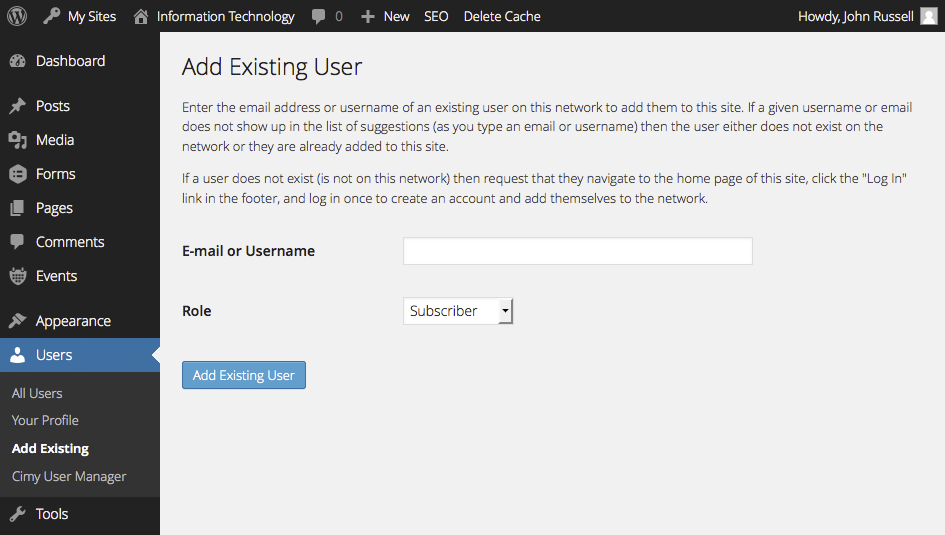
Screenshot - add existing user

Until now Site Managers needing to add someone (who already had an account on Multisite) to their website's people directory needed to notify us and we could add them. This adds work for Site Managers and us, and though it may be small every little bit counts so yesterday we created a new page in the Users section of the WordPress dashboard called "Add Existing". This page allows Site Managers to type in an email address or eName of anyone who already has an account on Multisite, select a role, and add them as a member of their website. Once added they can be listed on people directory pages and their profile can be viewed in the host website design.

It's not a huge change but it's one more step towards our mission, with the WordPress Multisite system, of empowering our departments and centers with control over their own websites.

Tech note: WordPress technically has this functionality built in, but only super-administrators can add an existing user as a member of a site without sending an invitation email to a person, which requires action on said persons part. The new "Add Existing" page allows Site Managers to add existing users immediately, without sending an invitation email.

Comments

  1. Thank you for sharing such insightful and updated information. The articles are well-written, organized, and filled with useful knowledge. I appreciate your effort in producing content that benefits readers.

  2. Thank you for posting this well-written article. The explanations are clear, informative, and easy to follow. I appreciate the effort behind creating content that is both useful and educational for readers.

  3. AI-assisted drafts often need more than corrected grammar: they need varied sentence rhythm, clearer transitions, and wording that fits the intended audience. An AI humanizer can support that revision process across Spanish, Portuguese, English, and Japanese, especially when the original draft sounds repetitive or overly formal. The final text should still receive a human review for factual accuracy, tone, terminology, and any subtle change in meaning introduced during rewriting.

  4. PDF attachments often become a practical issue on shared websites when staff need to upload forms, reports, biographies, or downloadable resources. ComprimirPDF offers a focused way to reduce those files in the browser without registration or server uploads. Local processing can be especially useful when a document includes internal details or personal information that should not be sent to an additional service. Smaller files may also make downloads easier for visitors on slower connections. After compression, checking text clarity, embedded links, and image quality helps ensure that the document remains usable.

  5. A useful tattoo brief should describe more than the central subject. It can specify placement, approximate size, line weight, shading, color limits, and the amount of open skin between separate pieces. Visual concept tools can help compare those choices before an artist consultation, especially when several small motifs must feel related without looking like a single sleeve. The generated image should remain a discussion reference, while the tattoo artist adapts composition and detail to the body.

  6. Spanish writing often needs more than a basic word total. Contador de Palabras combines live counts for words and characters with sentence analysis, readability indicators, keyword review, and rhythm checks. Bringing these signals into the editing view can help writers spot dense passages, excessive repetition, or sentences that interrupt the flow. It is relevant for articles, academic drafts, marketing copy, and any text that must fit a defined length while remaining clear and natural.

  7. A practical content workflow needs a stable draft that several people can review without losing the original message. HumanAIEdit addresses a relevant stage in that process: turning AI-assisted material into clearer, more natural, and still-editable copy. The strongest approach would keep terminology consistent across articles while allowing each author or department to retain an appropriate voice. Version comparison, factual review, and a final read for context are still essential before publication.

  8. Writers working with Japanese submission rules often need several measurements at once. A 原稿用紙 estimate translates the raw total into familiar 400-character pages, while separate counts for lines and paragraphs help with formatting checks. UTF-8 and Shift_JIS byte totals address a different requirement: technical storage or form limits. Updating all of these values in real time, with the text processed only in the browser, makes the calculation useful for both editorial planning and privacy-sensitive drafts.

  9. A local pdf converter is especially useful when the document contains notes, reports, or other material that should not be uploaded to an application server. Processing in the browser also removes the need to create an account before extracting editable Markdown. The practical boundary matters: text-based PDFs and clear English scans are suitable inputs, while complex layouts, handwriting, or poor scans may still require manual cleanup. Keeping headings, lists, and paragraphs editable makes the result easier to revise, search, or move into a documentation workflow.

  10. For teams managing several websites, content operations can become fragmented surprisingly quickly. RankOps AI addresses that problem by combining site-fit keyword research, editable draft creation, content review, and approved publishing through connected website workflows. Keeping these stages in one system can make ownership and status clearer: an opportunity is selected, a draft is prepared, an editor checks it, and only approved material moves forward. This model is especially sensible where accuracy and brand consistency matter, because automation supports the work without removing the human decision at the publishing boundary.

  11. Many hiring tools organize applicants or schedule interviews, but preparation quality depends on connecting the role’s requirements with the candidate’s specific claims. A useful interview guide should identify what needs verification, propose focused questions, describe credible answer signals, and suggest evidence to request. This gives the interviewer a practical route from a broad resume statement to a detailed discussion of scope, decisions, and individual contribution. The resulting structure can support consistency across interviewers while keeping every conversation relevant to the position.

  12. Choosing HR software becomes easier when the comparison starts with workflows rather than feature counts. A small organization can list its recurring tasks, identify where information is duplicated, and decide which records require permissions or audit history. Vendor comparisons should then cover integrations, data export, implementation effort, support, and total cost alongside core functions. It is also worth separating essential requirements from conveniences, because an oversized system can add administration without resolving the team’s most important bottlenecks.

  13. Punctuation marks that resemble one another can change the rhythm and meaning of a line. A middle dot is particularly useful when a separator should feel lighter than a dash yet more visible than a regular space, such as between compact labels or related terms. A good reference should make this distinction clear and show neighboring alternatives, helping users select a character based on reading flow instead of simply choosing the first similar mark available.

  14. Event information: WordPress Multisite shared faculty profile management feature introduction
    Content type: College of Liberal Arts website technical update
    Content overview: New “Add Existing” page released in WordPress dashboard for site managers to add existing multisite users to local website independently
    Web content can be made into attractive short videos with imagine-video.

Leave a Reply

Your email address will not be published. Required fields are marked *